


For effective and cost-efficient young stand maintenance: Innovative stem ring saw for precise and easy work and up to 80% time savings
Abstract
The presented technology concerns an innovative product in the form of a special hand saw (handle girdle saw) used in forestry for tending young stands. It is designed to simplify the girdle-making process and reduce the effort by up to 80%. This replaces the previous, more labor-intensive girdle-making methods and enables a sustainably higher yield from forest management.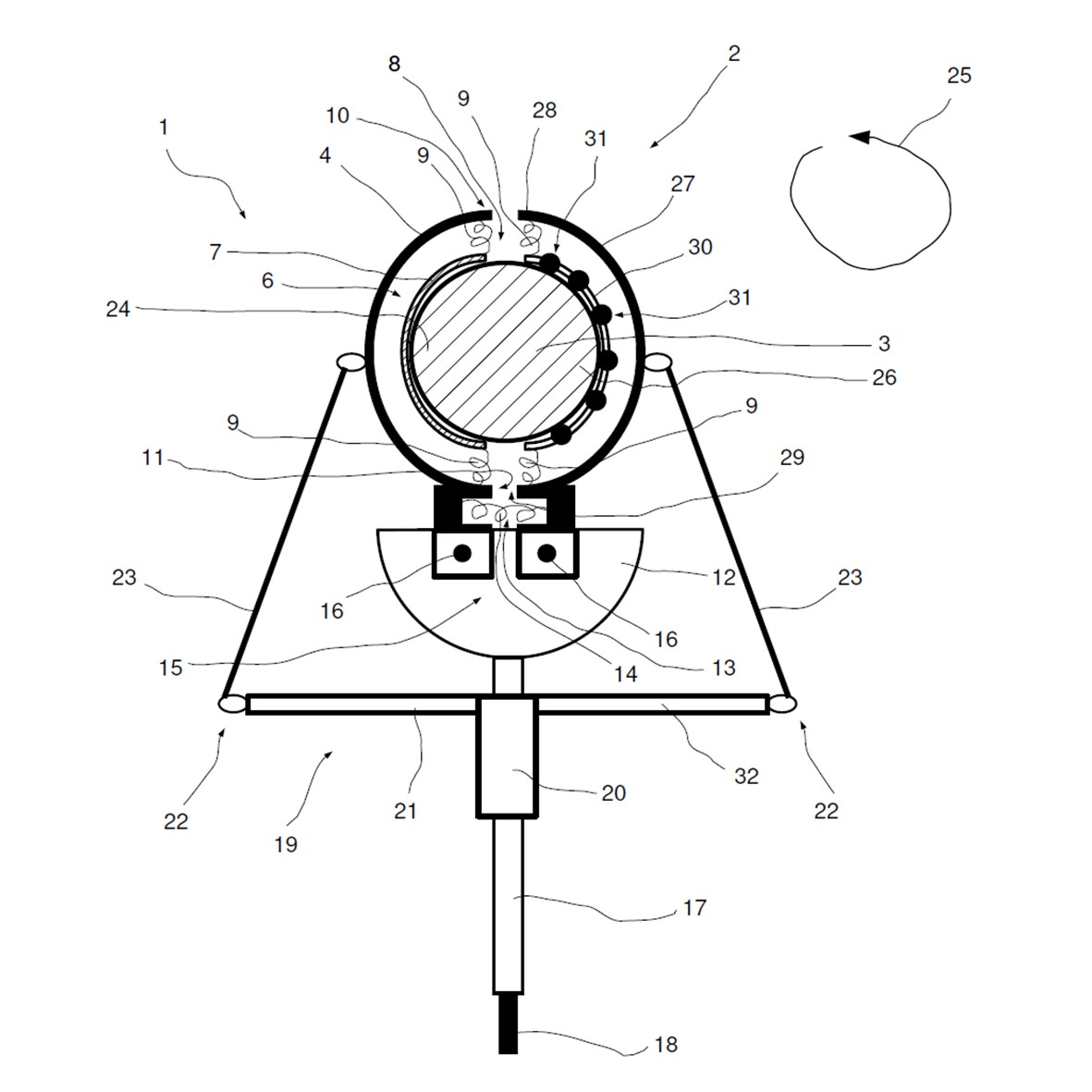
Fig. 1: Diagram of the stem ring saw (1) for treating a tree (3) [LU604348]

Fig. 2: Sustainably managed forest, symbolic image [AI-generated]
background
Young stand tending is carried out in forestry to promote and secure the stability, vitality, and quality of the forest from an early stage. By removing unwanted or highly competitive trees, future-proof trees receive more light, space, and nutrients. This promotes healthy growth, better wood quality, and the long-term resilience of the stand.
One pruning method is girdling, in which competing or so-called “super-strong” trees are selectively killed without endangering the supporting structure of the tree. In fruit growing, girdling is deliberately used to increase fruit production, as interrupting the sap flow allows more nutrients to reach the upper parts of the tree.
Currently, tools such as bark strippers, bark chains, and bark peelers are used. Precise work is required, as the bark and cambium must be completely removed, and only minimal penetration into the sapwood is desired. Imprecise work leads to cuts that are too deep or incomplete girdling. Because girdling is labor-intensive and therefore expensive, it is currently only used to a limited ex-tent, leaving potential in forest management and fruit growing untapped.
Innovation / Solution
The invention enables an ergonomic, safe and efficient execution of a uniform ring cut with low effort and high adaptability to different operating conditions. The core of the new solution is a cutting mechanism that encircles the tree trunk at the optimal girdle height, enabling precise manual cutting of the bark and cambium. This mechanism features at least one, preferably two, movable, curved arms that grip the trunk circumferentially, ensuring stable, slip-resistant positioning – even on slopes or uneven surfaces. A cutting element with at least one flexible, elongated cutting component, such as a cutting wire or saw chain, is spring-mounted on these arms. This spring mounting ensures a defined, uniform contact force, adapts to varying trunk diameters, bark structures, and elliptical cross-sections, and prevents insufficient contact and damage caused by excessive force. The legs are guided and can be moved from an open position to a ringed position by means of a means of movement, for example a linearly movable handle with a pulley mechanism.Benefits
You can close this window. You can find your search results in the previous window